Why North Dakota Driveways Take Such a Beating Every Spring
If you've lived in Central North Dakota for more than one winter, you already know what happens to a gravel driveway in April. The frost line here can push 5 or 6 feet deep in a hard winter. When the top foot or two thaws before the frozen subgrade underneath, that surface layer turns soft and unstable — any load on it punches right through. What was a firm, functional driveway in February becomes a rutted, heaved mess by the time the ground fully opens up.
The clay-heavy soils common throughout McLean, Burleigh, and surrounding counties make this worse. Clay holds water. It swells when it freezes and shrinks when it dries. That constant movement works gravel out of position, opens up low spots, and over time degrades the base that everything else depends on.
The good news is that most spring driveway problems are fixable — but understanding what you're actually dealing with determines whether a load of gravel solves it or just delays the problem for another season.
Step One: Let It Dry Before You Do Anything
The most common mistake is trying to fix a spring driveway too early. If the ground is still thawing or saturated from snowmelt, any gravel you add just gets pushed into the soft subgrade and disappears. Equipment driven on a wet, unfrozen driveway makes the ruts deeper, not shallower.
Wait until the ground has dried out enough that foot traffic doesn't leave deep impressions and water isn't pooling in the low spots for days after it rains. In Central ND this usually means sometime in May, though it varies year to year depending on how wet the spring has been.
A good rule of thumb: if your boots sink more than an inch walking across the driveway, it's too wet to work. Give it more time — repairs done on solid, dry ground last years longer than repairs done on soggy spring ground.
Assessing the Damage — What Are You Actually Looking At?
Not all spring driveway damage is the same, and the fix depends on the cause. Walk your driveway and look for these specific problems:
Surface ruts and soft spots
Ruts from tire tracks that formed when the ground was soft, or spots that still feel spongy underfoot. These are usually a gravel and grading issue — the surface material has been displaced or worn thin, and the subgrade may have been disturbed. A regrade and fresh gravel often solves this if the base is otherwise sound.
Frost heave bumps
Raised sections where the ground pushed upward during freezing. These typically settle back down as the frost leaves, but they can leave behind uneven grade that holds water. If the bumps don't settle flat on their own by late May, they need to be graded back down.
Persistent low spots and standing water
Water that pools in the same spot every spring isn't a coincidence — it's a drainage problem. Dumping gravel into a low spot without addressing where the water is coming from just creates a sinkhole that eats gravel year after year. Low spots need to be graded so water moves off the driveway, not through it.
Washouts at the driveway edges or culvert ends
Snowmelt and spring rain can erode the gravel away from driveway edges, especially on driveways with any slope to them. Culvert ends are particularly vulnerable — if the gravel has washed away from the headwalls, water will start undercutting the driveway surface and you'll have a bigger problem by fall.
A culvert that's not flowing
Culverts that were marginal going into winter sometimes heave, shift, or get crushed under freeze-thaw pressure. If spring water is backing up instead of flowing through, the culvert needs to be inspected. A plugged or collapsed culvert will undermine a driveway faster than almost anything else.
What You Can Handle Yourself vs. When to Call for Equipment
DIY-friendly repairs
- Filling small ruts with fresh gravel and tamping by hand or driving over repeatedly
- Raking displaced gravel back toward the center crown
- Cleaning debris from culvert ends so water flows freely
- Spreading a light topdressing of gravel on a surface that's worn thin but otherwise drains well
When equipment makes sense
- Significant rutting across a long section that needs the full width regraded and crowned
- Persistent low spots that require moving material and reshaping the drainage path
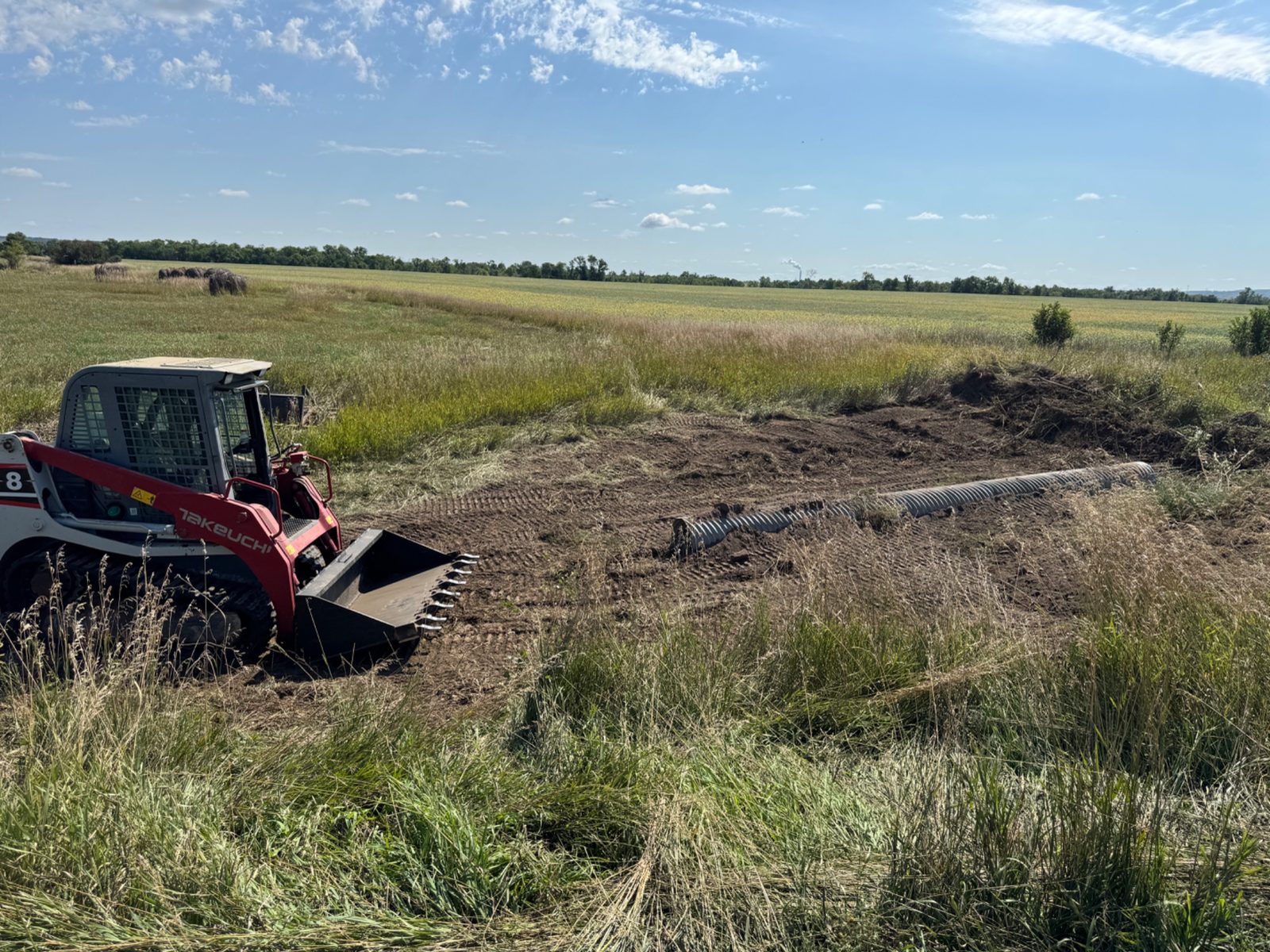
- A failed or shifted culvert that needs to be pulled and reset
- A driveway that's lost its crown entirely and sheds water to the sides instead of off the center
- Base failure — soft spots that keep returning in the same location no matter how much gravel you add
Base failure is the one that catches people off guard. If you've added gravel to the same spot two or three springs in a row and it keeps sinking, the problem isn't the surface — it's what's underneath. The subgrade needs to be stabilized, sometimes with geotextile fabric and a proper base course, before surface material will hold.
Getting the Crown Right — the Most Overlooked Part of Driveway Maintenance
A properly built gravel driveway has a slight crown — the center is higher than the edges, typically 3–4 inches of rise across a 12-foot width. That crown is what sheds water off the surface instead of letting it sit and soak in. Over years of use, the crown gets worn flat from tire tracks, and once it's gone, every rain event deposits water in the wheel tracks instead of moving it off the road.
Restoring the crown is one of the most effective things you can do for a deteriorating driveway, and it's something a blade or box scraper on a tractor can handle on shorter residential driveways. Longer driveways or those with significant grade changes usually benefit from a proper grader pass to get the slope right across the full width.
How Much Gravel Do You Actually Need?
A common question we get in spring is how many loads of gravel to order for a repair or topdress. The rough math: a standard end dump load is around 15 tons of gravel. For a 12-foot wide driveway, 15 tons will cover roughly 100–120 linear feet at about 2 inches of compacted depth — enough for a moderate topdress on a section that's worn but not severely rutted.
If you're filling significant ruts or rebuilding a section, plan for more material. It's always better to have a small surplus than to run short halfway through a repair. Give us a call with your driveway length and a description of the damage and we can help you estimate what you'll need before you order.
Timing Your Repair for the Best Results
In Central North Dakota, the sweet spot for driveway repair is typically mid-May through June. The ground has dried enough to support equipment, the frost is fully out, and you have the full summer season ahead for the surface to compact and settle before next winter. Repairs done in fall are fine but give less time to stabilize before freeze-up. Repairs done in wet spring conditions rarely hold well.
If your driveway is in rough shape heading into summer, getting it repaired before the dry heat of July sets in also makes the grading work easier — bone-dry clay is significantly harder to work than soil with a little moisture in it.
When It's Time to Rebuild, Not Just Repair
Some driveways reach a point where annual topdressing and patching stops being cost-effective. If the base has been compromised, if the culvert is failing, or if the drainage geometry is fundamentally wrong, the repairs needed every spring will keep adding up. At some point a proper rebuild — excavate the old surface, install geotextile fabric, bring in a base course, and finish with quality gravel — costs less over a 10-year period than repeated annual repairs that never fully solve the problem.
We're happy to take a look at a driveway that's been giving consistent trouble and give you a straight assessment of whether repair or rebuild makes more sense for your situation.